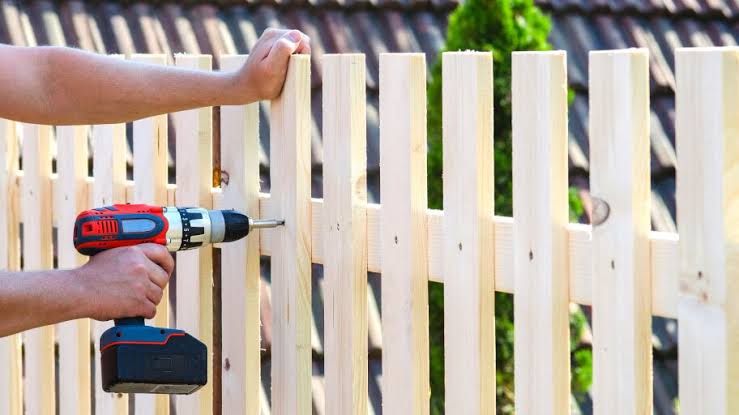
Why I’m Seeing More Good Fences Repaired, Not Replaced
A few years ago, a damaged garden boundary would often lead fairly quickly to a conversation about replacing the lot. That conversation is changing. More people are asking whether an existing fence can be saved, and in plenty of cases the answer is yes. A sensible fence repair can add years to a boundary without the cost, waste and disruption of pulling out perfectly serviceable materials.
I think that’s a positive change.
I’ve never subscribed to the idea that an old fence is automatically a bad fence. If the important parts are sound, age alone isn’t a reason to put it in a skip.
The difficulty is working out where sensible repair ends and false economy begins.
Fences rarely deteriorate evenly
This is one of the most useful things to understand about an ageing fence.
It doesn’t normally reach the end of its life all at once.
One post might sit in particularly wet ground and deteriorate years before the others. A panel beneath an overhanging tree may stay damp for longer. One section might receive the full force of the prevailing wind while another is sheltered by the house.
Gates introduce their own stresses.
Even the way a garden slopes can mean water collects around one part of a boundary while another remains relatively dry.
As a result, I regularly see fencing where perhaps 80 or 90 per cent of the structure is doing its job perfectly well, but one failed component makes the entire thing look tired.
That isn’t necessarily a replacement job.
It’s a diagnosis job.
Start with the posts
If I’m assessing whether an existing timber fence is worth repairing, I am far more interested in the posts than the colour of the panels.
Panels are obvious. Posts are structural.
A slightly weathered panel can continue working for years. A beautiful panel attached to a rotten post isn’t going to achieve much.
Timber posts deserve particular attention around ground level. This is where deterioration frequently occurs because the timber is repeatedly exposed to changing moisture conditions.
The top of the post can look absolutely fine.
I’ve seen posts where the visible timber still appeared reasonably healthy but the section around the ground line had deteriorated enough that you could almost push the fence over by hand.
That is why simply looking at a fence from a few metres away isn’t enough.
Push individual posts gently. Look for movement at the base. Check whether the concrete footing is moving with the post or whether the timber itself is moving inside it.
Those clues tell you far more than a quick glance at the panels.
One failed post doesn’t condemn the whole boundary
This is where homeowners can sometimes spend money unnecessarily.
Suppose you have a run of eight fence panels and one timber post has failed.
The remaining posts are solid. The panels are serviceable. The rails are sound. There is no widespread rot.
Why replace everything?
Provided the surrounding structure can be worked with safely, replacing or repairing the failed section may be all that is necessary.
The economics change when several posts begin showing the same symptoms.
If three have already failed and the remaining five are the same age, installed in the same way and beginning to soften around ground level, repairing them individually may simply mean paying for repeated visits over the next few years.
There isn’t a magic percentage at which repair becomes replacement.
You have to judge the condition of the whole structure.
That judgement is more useful than automatically recommending whichever option produces the bigger invoice.
Panels are often more repairable than people think
A damaged fence panel can look worse than it is.
One loose board doesn’t necessarily mean a failed panel. Neither does a small amount of movement in a rail.
Closeboard and feather edge fencing can be particularly useful in this respect because individual components can often be replaced without dismantling an entire boundary.
This is one reason I’ve always liked fencing systems that allow sensible maintenance.
If several feather edge boards become damaged, replace the boards.
If a rail fails but the posts remain sound, deal with the rail.
If a gravel board has cracked, investigate why and decide whether that component can be changed.
The situation is slightly different with prefabricated panels because they are more self-contained. Even then, a damaged panel between perfectly sound posts doesn’t automatically justify replacing every panel beside it.
Matching older fencing can sometimes be an issue, particularly once timber has weathered, but that’s an aesthetic decision rather than a structural one.
If somebody is happy for a new panel to weather naturally until it blends in, there is little reason to replace five good ones simply because the sixth has failed.
Gates tell a slightly different story
A badly behaving gate attracts attention quickly because you interact with it.
It drags.
It bangs.
The latch stops meeting the keep.
You lift it slightly every time you close it until one day you realise you’ve been doing that for six months.
The temptation is to replace the gate.
Sometimes that is correct. Sometimes the gate is the innocent party.
A supporting post that has moved by a surprisingly small amount can throw the entire opening out of alignment. The gate then appears to have dropped even though the frame itself remains reasonably square.
Hinges can loosen too, particularly where fixings have deteriorated or timber has split.
Before replacing garden gates, I would always want to establish whether the problem is the gate, the hardware, the post or some combination of the three.
Otherwise you risk hanging a brand-new gate from the same unstable post.
It will look lovely for a while.
Then you’ll be back where you started.
Repair has become a financial decision again
There is a broader reason homeowners are asking more questions about repair.
People are watching what they spend.
That doesn’t necessarily mean home improvement has stopped. It means homeowners are becoming more selective about where money goes.
There is a big difference between spending because something genuinely needs replacing and spending because replacement happens to be the easiest recommendation to make.
Fencing can represent a significant amount of material.
Take a long garden boundary. Full replacement could involve numerous posts, panels or boards, rails, gravel boards, concrete and fixings, plus the labour involved in dismantling and removing the existing structure.
If most of those existing components still have useful life left, retaining them can make financial sense.
The important word there is useful.
Cheap repairs to fundamentally failed fencing aren’t economical. They merely spread the cost of replacement across several frustrating episodes.
There is an environmental argument too
Throwing usable material away has never made much sense to me.
Fencing isn’t unique in this respect. We have become accustomed to replacing entire products because one component has failed.
A fence is often much simpler.
It is a collection of posts, rails, boards, panels, gravel boards and fixings. Depending on the system, many of those components can be assessed independently.
If six sound panels can stay where they are while one damaged section is repaired, that is six panels that don’t need manufacturing, transporting and disposing of.
Timber has obvious environmental considerations, but the same logic applies to concrete and composite materials. Extending the working life of something already installed can be preferable to unnecessary replacement.
This shouldn’t become an excuse to keep genuinely rotten fencing alive indefinitely.
There comes a point where the material has done its job.
The aim isn’t to avoid replacement forever. It is to replace things when they actually need replacing.
Concrete posts can change the calculation
One of the reasons concrete post and gravel board systems remain popular is their ability to outlast the timber components fitted between them.
If the posts are sound and properly installed, tired timber panels can often be replaced independently.
That creates a very different repair calculation from a timber system where the structural posts themselves are failing.
Concrete isn’t indestructible.
Posts can crack. Ground movement can push them out of alignment. Poor installation can cause problems regardless of the material used.
And concrete components are heavy. That matters when repairing fencing because you don’t simply want to drop heavier materials into an existing structure without checking that everything supporting them is stable.
But a good existing concrete framework can make refurbishment remarkably straightforward.
Composite doesn’t eliminate the need for judgement
Low-maintenance materials have become increasingly prominent in modern fencing installations, and understandably so.
Composite boards don’t behave exactly like timber and aren’t vulnerable to rot in the same way.
That doesn’t mean every component around them lasts forever.
Posts can move. Fixings can fail. Ground conditions can change. Gates can shift. Installation errors can still reveal themselves.
No fencing material compensates for poor foundations.
I’ve seen people become fixated on the expected lifespan of the visible material while ignoring what is supporting it. I’d rather have a modest fencing material installed on properly considered foundations than an expensive one sitting on inadequate posts.
The underground work isn’t exciting.
It is still where a large part of the lifespan is decided.
Beware the endless patch-up
There is a point where I stop advocating repair.
You usually recognise it because each repair exposes the next problem.
A post is replaced, then another moves.
A rail is repaired, but the boards around it are deteriorating.
A panel is replaced, but the posts aren’t really strong enough to support it.
The gate is adjusted repeatedly because the entire opening continues moving.
At that stage, you’re not maintaining a good fence. You’re nursing a failing one.
Money spent on repeated labour could be going towards a properly installed replacement.
There is also a practical benefit to doing the whole job once. Old concrete can be removed where necessary, post positions can be corrected, levels reconsidered and drainage or ground problems dealt with rather than inherited.
Sometimes starting again is absolutely the right answer.
It just shouldn’t be the automatic answer.
A repair should buy something worthwhile
Whenever somebody is considering repairing an existing fence, I think the useful question is not simply, “Can this be repaired?”
Almost anything can be repaired if you’re determined enough.
The better question is, “What am I getting for the money?”
If a modest repair is likely to provide several more years from otherwise sound fencing, it can be excellent value.
If you’re spending substantial money to gain another winter from a boundary that is failing in multiple places, save it.
Fencing has become expensive enough that homeowners are right to question unnecessary replacement. Materials have value. Labour has value. Existing fencing that still works has value too.
A good contractor shouldn’t be looking for the biggest job that can be sold.
They should be looking at what is actually broken.
Sometimes that’s the entire fence.
Quite often, it isn’t.