Flex LED Wall Washers for Modern Building Facades
Illuminated facades have become a signature element of contemporary architecture. From subtle grazing on stone textures to bold color‑changing skylines, LED wall washers are the core tools that turn building envelopes into visual landmarks. Properly designed wall‑washing schemes don’t just “light up” a surface—they sculpt form, emphasize material, and support the building’s identity at night while meeting energy and maintenance constraints.
This article introduces key concepts, design strategies, and practical considerations for facade wall‑washing, with a particular focus on how flexible LED wall washer solutions enable designers to handle complex geometries, curves, and retrofit constraints that traditional rigid fixtures struggle with.
What Is Wall Washing for Facades?
In lighting design, wall washing refers to lighting techniques that create a broad, even distribution of light across a vertical surface. On facades, that can mean:
- Uniformly lighting large surfaces for a clean, monolithic look.
- Grazing textures like stone, brick, or perforated metal to highlight depth and relief.
- Accenting structural elements—columns, fins, frames, or cornices.
The goal changes from project to project: some buildings want a soft, dignified presence at night; others aim to become dynamic, colorful icons. LED wall washers are the instruments that turn these goals into controlled, repeatable effects.
Why Use LED Wall Washers on Facades?
LED wall washers have largely replaced traditional discharge and halogen solutions on facades for several reasons:
- Energy efficiency: Modern LEDs offer high lumen output with low power consumption, ideal for large surfaces that run many hours per night.
- Longevity and low maintenance: Reduced relamping needs are critical for high or difficult‑access facades.
- Precise optics: Multiple beam angles and grazing optics allow designers to tailor light distribution to specific materials and geometries.
- Color control: Single CCT, tunable white, and RGB/RGBW options support both static and dynamic concepts.
- Compact form factors: Slim linear or flexible systems integrate more easily into architectural lines and details.
These characteristics make LED wall washers a natural fit for both new builds and facade retrofits.
Design Objectives for Facade Wall Washing
Before choosing fixtures, clarifying design intent is essential. Common objectives include:
1. Reveal Form and Material
- Highlight verticality, rhythm, or structural expression.
- Emphasize textures (stone, brick, perforated metal) through grazing.
2. Create Nighttime Identity
- Establish a recognizable look after dark.
- Use color or contrast to differentiate the building in its context.
3. Support Wayfinding and Safety
- Illuminate entrances, projections, and circulation zones.
- Avoid dark voids or uncomfortable contrast around public interfaces.
4. Respect Context and Regulation
- Control light spill to reduce light pollution and neighbor disturbance.
- Meet local ordinances on brightness, color, and operating hours.
Clear priorities help determine whether to use uniform washes, strong grazes, accent pockets, or dynamic color systems—or a combination of these.
Core Types of LED Wall Washer Approaches
1. Traditional Linear Wall Washers
Rigid linear fixtures mounted at the base or top of the facade:
- Available with a range of beam optics (wide, narrow, elliptical, grazing).
- Provide robust performance and easy alignment in rectilinear facades.
- Best suited for long, straight runs and repeated structural modules.
2. Projectors and Spot Wall Washers
Compact projectors with asymmetric wall‑wash optics:
- Useful for targeting specific bays, columns, or features.
- Easier to adjust individually for fine‑tuning on site.
- Often used in combination with linear fixtures for layered effects.
3. Flexible LED Wall Washer Systems
A more recent development is flexible LED wall washer solutions—linear grazing or wall‑wash modules built on bendable substrates or articulated housings, allowing them to:
- Follow curves, arcs, and angled planes.
- Wrap around corners or non‑orthogonal volumes.
- Integrate into complex facade details and retrofits where rigid bars cannot fit cleanly.
These flexible systems are particularly valuable for contemporary facades with dynamic forms, parametrically designed cladding, or retrofits to older buildings with irregular surfaces.
Key Design Variables for Facade Wall Washing
1. Mounting Position and Distance
- Bottom‑up mounting: Fixtures at grade or on low ledges washing upward; emphasizes height but needs careful glare control.
- Top‑down mounting: Fixtures at parapets or rooflines washing downward; reduces glare at pedestrian level but complicates maintenance.
- Mid‑height integration: Fixtures mounted within facade elements (ledges, mullions, fins) washing both up and down.
The distance from the wall affects beam overlap, uniformity, and grazing intensity.
2. Beam Angle and Optics
- Wide wall‑wash optics create uniform brightness on relatively smooth surfaces.
- Narrow or grazing optics emphasize texture, creating strong shadow and relief.
- Asymmetric beams direct light away from the fixture and onto the surface, minimizing spill.
Correct optics selection is crucial to avoiding scallops, hot spots, and uneven patches.
3. Color Temperature and Rendering
- Warm whites (2700–3000 K) complement historic stone, brick, and warm finishes.
- Neutral whites (3000–4000 K) suit contemporary glass, metal, and mixed‑use facades.
- High CRI is important when facade materials have rich color or when accurate rendering matters (e.g., cultural buildings).
For dynamic projects, RGB/RGBW or tunable white wall washers allow seasonal, event‑based, or brand‑driven changes.
4. Intensity and Uniformity
- Too much brightness can cause glare, light pollution, and loss of subtlety.
- Insufficient output may leave the building visually flat or fragmented.
- Uniformity should be consciously chosen: sometimes a gentle gradient is more expressive than perfectly even illumination.
Mock‑ups and calculations are the best way to fine‑tune these variables before full deployment.
Where Flexible Wall Washer Solutions Stand Out
While rigid wall washers are effective for many projects, flexible LED wall washer solutions open up additional design possibilities, especially for:
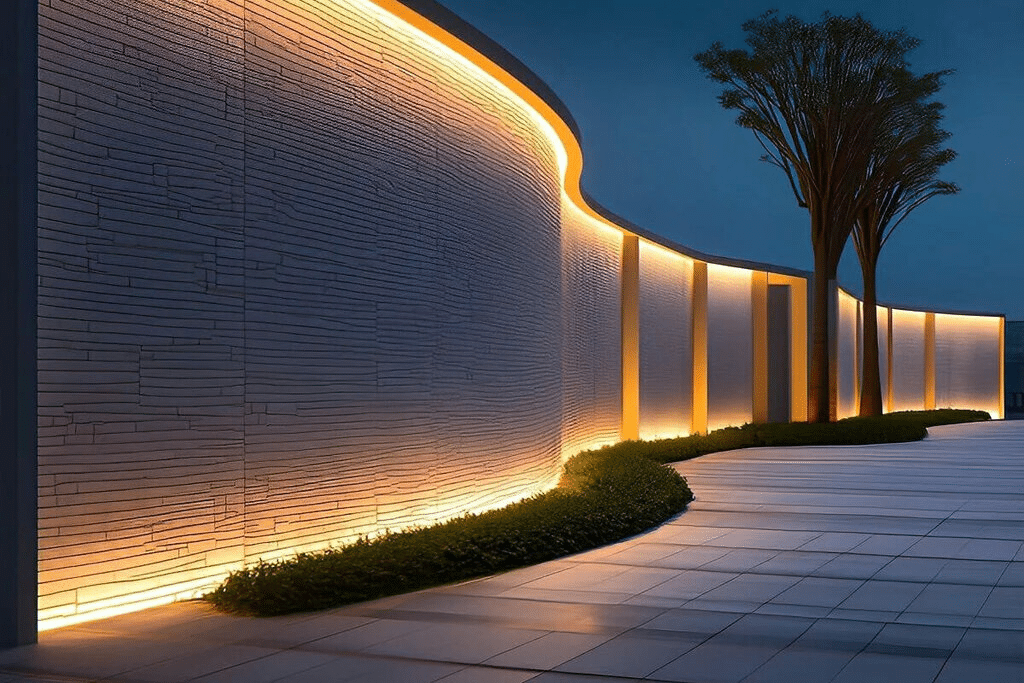
1. Curved Facades and Organic Forms
- Buildings with curved glass, metal panels, or undulating cladding need luminaires that follow their geometry.
- Flexible wall washer lines can hug contours and maintain consistent offset, preserving uniformity.
2. Complex Retrofits
- Existing facades may lack convenient mounting lines or may have irregular surfaces.
- Bendable or articulating wall washer systems can navigate these irregularities while still delivering coherent light patterns.
3. Integrated Detail Lines
- Flex systems can be concealed within reveals, cornices, or custom channels.
- Continuous linear grazes along horizontal or vertical breaks emphasize architectural rhythm without visually adding “fixtures” to the facade.
Project‑focused product families of flexible wall washers—designed specifically for facade use and presented as complete systems with optics, mounting, and control compatibility—provide a powerful toolset for such conditions. Manufacturers that offer dedicated flexible LED wall washer solutions for facades, such as those exemplified in specialized product ranges, give designers a practical path from concept to buildable detail.
Controls and Dynamic Facade Concepts
Modern facades increasingly move beyond static white light:
- Dimming allows adjustment for late‑night energy savings and reduced brightness when ambient light is low.
- Scene presets support event modes (holidays, corporate events, cultural celebrations).
- Color‑changing systems (RGB/RGBW) can be mapped to building zones, creating low‑resolution media facades.
When specifying wall washers:
- Decide early whether control will be simple (on/off + dimming) or advanced (DMX, DALI, Art‑Net, etc.).
- Ensure drivers and fixtures support the required protocol.
- Plan power and data distribution along the facade with access for commissioning and maintenance.
Even for static schemes, integrating dimmable drivers is advisable to fine‑tune brightness after installation.
Practical Considerations for Facade Wall Wash Design
1. Glare and Light Pollution
- Position fixtures and aim beams to minimize direct view of LEDs from pedestrian zones and neighboring buildings.
- Use visors, louvers, or shielding where necessary.
- Avoid projecting light above the roofline to reduce sky glow.
Thoughtful design can enhance the building without disturbing the urban night environment.
2. Durability and IP Ratings
- Choose appropriate IP and IK ratings for location (rain exposure, wind‑blown debris, vandalism risk).
- Consider corrosion‑resistant materials for coastal or industrial environments.
- Verify operating temperature ranges for both fixtures and drivers.
3. Maintenance Access
- Plan how fixtures will be cleaned, adjusted, or replaced over time.
- Cluster drivers in accessible locations where possible, rather than scattering them in difficult‑access voids.
- Keep wiring routes documented and logically segmented by zones.
4. Coordination with Architecture and Structure
- Integrate mounting details into facade drawings early—avoid last‑minute surface‑mounted compromises.
- Coordinate with cladding, glazing, and waterproofing strategies to avoid unintended penetrations or thermal bridges.
- Allow for fixture tolerances and aiming adjustments in the detail design.
Example Facade Scenarios
Historic Stone Building
- Warm white wall‑grazing from flexible washers set close to the wall emphasizes texture and vertical rhythm.
- Lower intensity late‑night scenes respect the historic district’s atmosphere.
Contemporary Glass and Metal Tower
- Neutral white linear washing articulates podium and crown zones.
- Vertical flexible washers in mullion lines create a subtle night‑time grid that unifies the facade.
Mixed‑Use Urban Block
- Different facade segments (retail podium, office levels, residential terraces) each get tailored wall‑washing treatments.
- Flexible washers contour around balconies and recesses, maintaining uniform visual language.
Choosing the Right Partner and System
For facade work, product choice and manufacturer support are as important as concept design:
- Look for project‑oriented systems with clear specification options (CCT, output, optics, mounting).
- Ensure flexible wall washer lines are backed by proper photometric data and facade‑specific accessories.
- Evaluate experience with similar projects and the ability to provide mock‑ups or sample sections.
When a system is designed explicitly as a flexible LED wall washer solution for facades—complete with compatible profiles, brackets, and control options—it significantly reduces risk and accelerates the path from design to built reality.
Conclusion
LED wall washers are a fundamental tool in contemporary facade lighting, shaping how buildings appear and communicate after dark. By carefully defining objectives, selecting appropriate optics and mounting strategies, and leveraging both rigid and flexible LED wall washer solutions, designers can craft facades that are expressive, efficient, and context‑sensitive.
When treated as an integrated system—combining fixtures, controls, architecture, and long‑term maintenance strategies—facade wall‑washing becomes not just decorative, but a core component of how architecture participates in the night‑time cityscape.