How Much Does an Inground Pool Cost? 2026 Pricing Guide
An inground pool costs $40,000 to $120,000 for most homeowners, with the national average landing around $55,000 to $80,000 depending on material and region. Vinyl pools run $40,000 to $65,000 installed. Fiberglass pools run $30,000 to $85,000. Concrete (gunite) pools run $60,000 to $120,000+, with high-end custom builds reaching $200,000 or more. Regional pricing varies dramatically — a $50,000 vinyl pool in a low-cost market can cost $80,000+ in Chicago, and Dallas pool installations average $81,410 according to Angi data.
The headline price isn’t the whole story, though. The construction quote covers the pool itself but rarely covers the fencing, decking, permits, electrical work, gas lines, and landscape restoration that make a pool actually usable. These add-ons routinely add 30 to 60 percent on top of the construction cost. And the 10-year ownership picture reorders the material comparison meaningfully — vinyl is cheapest to install but most expensive to own; concrete is most expensive to install but cheapest to maintain over decades. This guide breaks down what each pool type actually costs, what’s missing from the headline price, and how to think about pools as lifestyle purchases rather than financial investments.
Three pool materials, three different price points
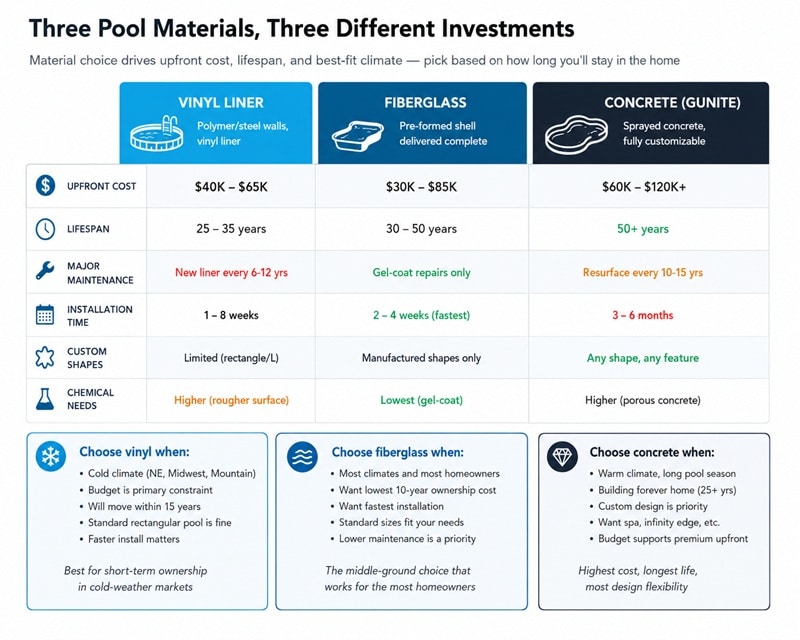
Pool pricing is structured primarily around the construction material. Each has different upfront cost, lifespan, maintenance profile, and best-fit climate.
Vinyl-liner pools — $40,000 to $65,000 installed
A polymer or steel wall structure with a flexible vinyl liner forming the pool surface. The cheapest option upfront and the fastest to install (typically 4 to 8 weeks from start to finish). The vinyl liner needs replacement every 6 to 12 years at $4,000 to $5,000 per liner. The wall structure typically lasts 25 to 35 years before requiring full pool replacement.
Best for: Cold climates with shorter pool seasons (Northeast, Midwest, Mountain West), budget-conscious buyers, homeowners who plan to move within 15 years.
Fiberglass pools — $30,000 to $85,000 installed
Pre-formed shells manufactured at a factory and delivered to the site for installation. The fastest installation type (1 to 3 weeks) because the shell arrives complete. Smooth gel-coat surface resists algae and reduces chemical use. Limited to manufactured shapes and sizes — typically up to 16 feet wide and 40 feet long, since the shell has to be transported by truck.
Best for: Most climates and most homeowners as the middle-ground choice. Lowest 10-year ownership cost across most scenarios.
Concrete (gunite or shotcrete) pools — $60,000 to $120,000+, with custom builds reaching $200,000
Sprayed concrete formed in any shape over a steel reinforcement frame. The highest upfront cost and longest installation time (typically 3 to 6 months). The only material that supports custom shapes, beach entries, infinity edges, swim-up bars, and integrated spas. Surface requires resurfacing every 10 to 15 years at $10,000 to $20,000.
Best for: Warm climates with long pool seasons, homeowners building their forever home, custom design priorities, larger or unusually shaped lots.
The national average across all three materials sits between $55,000 and $80,000. Your specific number depends primarily on which material matches your climate and timeline, secondarily on size and complexity.
The 10-year ownership cost picture
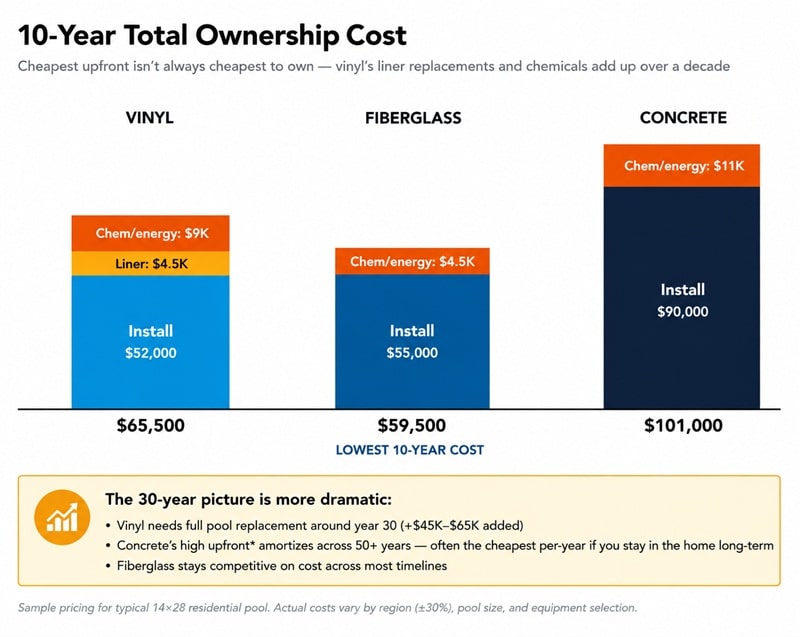
Construction price is the visible cost. Ownership cost is the invisible one. Looking at total spending over a 10-year window changes the material comparison meaningfully.
Vinyl over 10 years: $52,000 to $80,000 total
Initial install $40K-$65K. One liner replacement during the period at $4K-$5K. Higher chemical and energy costs from rougher liner surface ($600-$1,200/year additional vs. fiberglass). Standard repairs and equipment service. The cheapest upfront option but ownership cost climbs significantly over the decade.
Fiberglass over 10 years: $35,000 to $95,000 total
Initial install $30K-$85K. No liner replacement needed. Smooth gel-coat surface keeps chemical and energy costs lower ($300-$600/year savings vs. vinyl). Standard repairs and equipment service. Often the lowest 10-year cost despite mid-range upfront pricing.
Concrete over 10 years: $70,000 to $145,000 total
Initial install $60K-$120K+. No mandatory resurfacing in first 10 years (typically due in years 10-15). Higher chemical use due to porous surface ($800-$1,500/year more than fiberglass). Standard repairs. Highest absolute cost but spread across 50+ years of expected lifespan.
The 30-year picture is meaningfully different
Vinyl typically requires full replacement around year 30, adding another $40K-$65K to the lifetime cost. Concrete continues with resurfacing every 10-15 years but doesn’t require structural replacement in normal residential use. Fiberglass falls in the middle.
The honest summary: vinyl is cheapest if you’ll move within 10-15 years, concrete is cheapest if you’ll stay in the home 25+ years, fiberglass is the safest choice across most timelines.
What’s not in the headline price
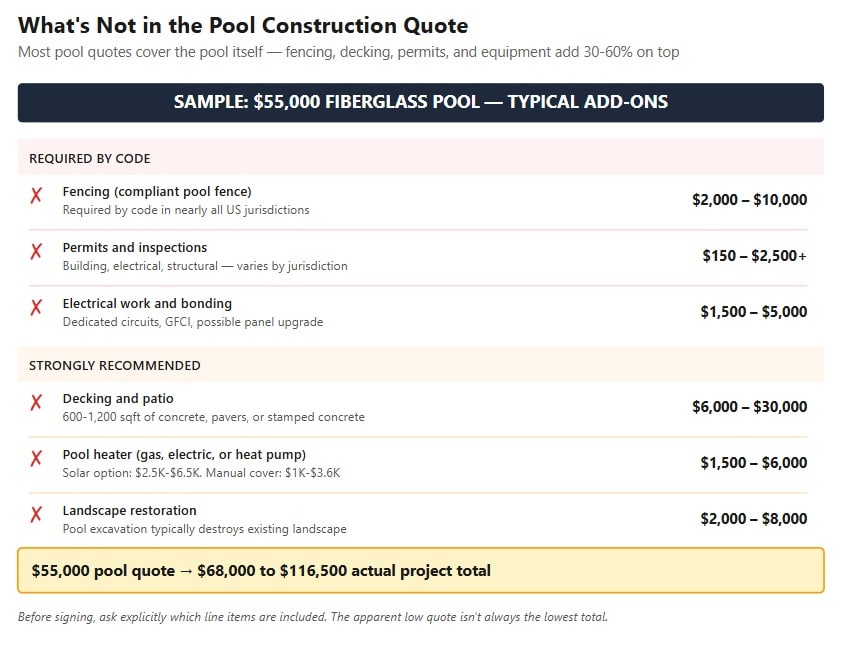
Most pool quotes cover the pool construction itself. They rarely cover everything else needed to actually use the pool. Before signing, verify which items are in the quote and which are extras.
Fencing — $2,000 to $10,000
Required by code in nearly all US jurisdictions for residential pools. Specific requirements vary (height, gate type, alarm requirements) but typical residential fencing for a pool runs $20-$40 per linear foot installed. A pool requires roughly 100-200 linear feet of compliant fencing depending on yard configuration.
Decking and patio — $6,000 to $30,000
Concrete decking around the pool runs $8-$15 per square foot. Pavers run $12-$25 per square foot. Stamped or decorative concrete runs $15-$25 per square foot. A typical 600-1,200 square foot pool deck adds significantly to the project total.
Permits and inspections — $150 to $2,500+
Permit fees vary enormously by jurisdiction. Suburban areas often run $200-$500. Major metros can run $1,500-$2,500 with multiple inspections required (electrical, structural, final). High-cost markets sometimes require additional engineering review fees.
Electrical work — $1,500 to $5,000
Pools require dedicated circuits for pumps, heaters, lighting, and automation systems. Older homes may need panel upgrades to support the additional load. GFCI protection and bonding (electrical grounding of metal components) are required by code.
Gas line installation — $1,500 to $3,500
If you’re heating the pool with natural gas, a dedicated gas line from the meter to the pool equipment pad is needed. Distance from the meter and access difficulty drive the cost.
Tree removal and landscape work — variable
Mature trees in the pool area need removal ($300-$2,000+ per tree, see our 30-foot tree removal guide for specifics). Existing landscaping is typically destroyed during pool excavation and needs restoration. Budget $2,000-$8,000 for landscape repair after construction.
Pool equipment beyond the basics:
- Pool heater: $1,500-$6,000 (gas, propane, electric, heat pump); solar $2,500-$6,500
- Automatic pool cover: $8,000-$20,000 installed
- Manual cover: $1,000-$3,600
- Pool lights: $700-$1,800
- Saltwater conversion system: $1,500-$3,000
- Variable-speed pump (energy efficient): $700-$1,500 above standard
A complete budget for a vinyl pool with basic decking, fencing, and equipment runs roughly $60,000 to $90,000 — meaningfully above the $40K-$65K construction-only quote. A concrete pool with full deck, fencing, decorative features, and premium equipment can reach $150,000+ before any unusual site conditions.
When evaluating quotes, ask specifically which items are included and which are extras. The answer often determines whether the apparent low quote is actually the lowest total.
Regional pricing reality
Pool pricing varies dramatically by region in ways that other home improvement projects don’t.
West Coast and Northeast: 30 to 50 percent above national averages. Higher labor costs, stricter building codes, longer permit processes, and limited contractor availability all stack. A vinyl pool that costs $50,000 in Texas might cost $75,000 in Massachusetts.
Texas and the Southeast: At or near national averages. Long pool seasons mean high contractor competition. Texas in particular has well-established pool industries with consistent pricing. Dallas-area inground pool installation averages $81,410 according to Angi.
Midwest and Mountain West: Below national averages on labor but with significant climate considerations. Shorter pool seasons (typically Memorial Day to Labor Day) mean concrete pools’ premium price is harder to justify. Vinyl dominates these markets.
Florida and the Southwest: Higher pricing for screened-enclosure pools (common in Florida) and for desert-region pools (where soil conditions add cost). Long pool seasons make the investment more financially defensible.
Specific city averages from current data:
- Dallas, TX: $54,000-$84,000 for a 12×24 pool
- Chicago, IL: $80,000+ starting for concrete pools
- Philadelphia, PA: $40,000-$120,000+ across materials
- Phoenix, AZ: $45,000-$100,000 typical
The regional spread can exceed 100 percent for the same pool. Get quotes from local builders before assuming any cost article’s averages apply to your specific market.
ROI: the honest math
Pool ROI gets discussed two ways in real estate, and it’s worth being clear about both.
The “7 percent home value increase” claim
Multiple sources, including the Pennsylvania Association of Realtors and Latham Pool’s data, suggest a backyard pool increases home resale value by approximately 7 percent compared to similar homes without pools. This is a real number with caveats: it varies enormously by region (much higher in Florida, Texas, Arizona; minimal in Minneapolis or Seattle), and it depends on whether the pool is well-maintained at sale time.
The “56 percent cost recovery” claim
The National Association of Realtors’ Remodeling Impact Report estimates homeowners recoup approximately 56 percent of inground pool costs at sale. This is the more useful framing — pools are not investments that pay back their full cost, they’re lifestyle purchases that recover roughly half their value.
The honest summary: A $70,000 pool typically increases home value by approximately $40,000 in pool-friendly markets. The $30,000 difference is what you’re paying for ownership and use of the pool. If you’ll use it heavily for 15+ years, the per-year cost is reasonable for the lifestyle benefit. If you’re considering a pool primarily as a financial investment, the math doesn’t favor it.
Two specific situations where pools work better financially:
- Hot climates with long pool seasons. The buyer pool that values a pool is larger, recovery rate is higher, and use of the pool is greater.
- Higher-end neighborhoods where pools are expected. In neighborhoods where comparable homes typically have pools, not having one can actually depress your home value. Adding a pool brings the home up to neighborhood expectations.
Two situations where pool math doesn’t work:
- Cold climates with short seasons. Pool ROI is significantly lower, ownership costs (winterization) are higher, and use is limited to 3-4 months per year.
- Below-median neighborhoods where pools are uncommon. A premium feature in a non-premium neighborhood often doesn’t recover anything close to 56 percent.
Financing considerations
Most pools are financed rather than purchased outright. Three common approaches.
Pool-specific loans through pool builders
Many large pool companies partner with lenders offering pool-specific financing. Rates are typically slightly higher than HELOCs. Terms run 10-20 years. Convenient because the financing is bundled with the build, but the rate premium can add $5,000-$15,000 over the loan life compared to other options.
Home equity line of credit (HELOC) or home equity loan.
Generally the best rates available because the pool is secured by home equity. Requires sufficient equity in your existing mortgage. Variable rate HELOCs carry interest rate risk over the project timeline.
Cash-out refinance
Replacing your existing mortgage with a larger one and taking the difference as cash for the pool. Rate depends on current mortgage market vs. your existing rate. Often makes sense only if current rates are below your existing mortgage rate.
Personal loans
Higher rates but unsecured (no home equity required). Sometimes used for smaller pool projects or by homeowners without significant equity.
The financing approach matters more for total cost than most homeowners initially realize. A $70,000 pool financed at 8 percent for 15 years costs approximately $35,000 in interest over the loan period — meaningfully more than the difference between vinyl and fiberglass construction. Worth comparing rates carefully before committing.
Timeline expectations
Pool projects take longer than most home improvement projects, and the timeline depends heavily on material.
Fiberglass: 2 to 4 weeks total project
Excavation, shell delivery, installation, plumbing, electrical, decking, and finishing. Fastest because the shell arrives complete from the factory.
Vinyl: 4 to 8 weeks total project
Excavation, wall installation, floor preparation, liner installation, plumbing, electrical, decking. Faster than concrete but slower than fiberglass because of the on-site wall and floor construction.
Concrete: 3 to 6 months total project
Excavation, steel reinforcement installation, concrete (gunite/shotcrete) application, plaster/finish curing time, plumbing, electrical, decking. The longest because concrete needs cure time at multiple stages, and each stage requires inspection before proceeding.
Permitting and pre-construction: 4 to 12 weeks before any work begins
Permit applications, engineering review (where required), HOA approval (where applicable), and contractor scheduling. The biggest scheduling variable in the project — well-rated contractors are often booked 6+ months out, especially in markets with seasonal demand.
A homeowner deciding to build a pool in March is typically swimming by July or August for fiberglass, late summer for vinyl, and the following spring for concrete. Decisions made in fall typically result in spring or summer pool readiness the following year.
DIY: not recommended
Pool installation is one of the most thoroughly professional-only home improvements. The reasons are stacked.
Excavation requires specialized equipment and skill — a poorly excavated pool sets up structural problems that can’t be fixed without re-excavation. Plumbing requires specific knowledge of pool circulation, suction safety (drain entrapment risk is a documented child fatality hazard), and code compliance. Electrical work involves bonding, GFCI protection, and high-current service that’s beyond most homeowners’ comfort. Permitting requires plans drawn by qualified professionals in most jurisdictions. Insurance coverage typically requires professional installation — many homeowners insurance policies exclude DIY-installed pools entirely.
The realistic DIY scope is small: pre-construction landscape removal, post-construction landscape restoration, equipment maintenance, and routine pool care after the pool is built. The pool itself is professional work.
Frequently asked questions
How long does an inground pool last?
Vinyl pools last 25 to 35 years before requiring replacement (with liner replacements every 6-12 years during that span). Fiberglass pools last 30 to 50 years with proper care. Concrete pools last 50+ years with resurfacing every 10-15 years.
Can I use my pool year-round?
In Florida, Arizona, Hawaii, and parts of California — yes, especially with a heater. In moderate climates (Georgia, Texas, Southern California) — typically March through October. In cold climates (Northeast, Midwest, Mountain West) — Memorial Day through Labor Day, with possible shoulder-season use.
Will a pool raise my property taxes?
Yes, in most jurisdictions. The pool addition increases the assessed value of the property, which increases property tax. The increase varies by location but typically runs $200-$1,500 per year in additional taxes. This is a recurring cost worth budgeting.
How much does pool maintenance cost annually?
Self-maintenance with chemicals and basic equipment runs $700-$1,500 per year. Professional maintenance service runs $1,200-$2,400 per year for typical residential pools. Energy costs (pump, heater, lighting) add $500-$1,500 per year depending on use and equipment efficiency.
Should I buy a pool or build one?
If you’re buying a home with an existing pool, get a thorough pool inspection ($300-$500) before closing. Pools 15+ years old often need significant repairs that aren’t visible during a standard home inspection. Existing pools are sometimes a good deal (the previous owner paid the construction premium) and sometimes a money pit (deferred maintenance can cost $20,000-$50,000 to address).
What size pool should I get?
For a family of four to six, a 14×28 or 16×32 pool is typical and adequate for most use cases. Larger pools (18×36+) are common in larger lots or where adult lap swimming is a priority. Smaller pools (12×24) work for smaller lots and primarily-children use. Pool size drives material cost roughly linearly — doubling the surface area roughly doubles the construction cost.
Saltwater or chlorine?
Saltwater pools use a salt cell to generate chlorine on-site, eliminating the need to add chlorine manually. Upfront cost is $1,500-$3,000 above standard chlorine systems. Operating costs are lower over time. Most homeowners building new pools today choose saltwater for the convenience and gentler feel on skin and eyes.
Heat pump or gas heater?
Heat pumps cost more upfront ($3,500-$6,000) but operate at roughly one-third the cost of gas heaters. Gas heaters cost less ($1,500-$3,500) but are more expensive to operate. Heat pumps work best in mild climates; gas works in any climate including cold-weather use. Solar heaters are an option in sun-rich climates but performance varies seasonally.
What about pool insurance?
Pools typically increase homeowners insurance premiums by $50-$200 per year due to liability exposure. Some insurers require specific safety features (compliant fencing, alarms, covers) before they’ll insure pool properties. Disclose the pool to your insurer immediately upon completion — failure to disclose can void coverage.
Can I add a pool later if I’m not sure now?
Yes, pools can be added any time as long as the lot supports them. The cost is the same whether built immediately or 10 years later (adjusted for inflation and material price changes). The decision often comes down to lifestyle timing — pools are most valuable to families with children at home, which is typically a 10-15 year window.