Can You Use Windex on Stainless Steel? The Honest, Chemistry-Backed Answer
You’ve just wiped your stainless steel fridge with Windex for the fifth Saturday in a row, and it looks worse than when you started. Streaks in the grain. A weird cloudy haze near the handle. Fingerprints that somehow multiplied. At some point, the question stops being “am I doing this wrong?” and becomes the bigger one: can you use Windex on stainless steel at all, or have you been quietly damaging your appliances this whole time?
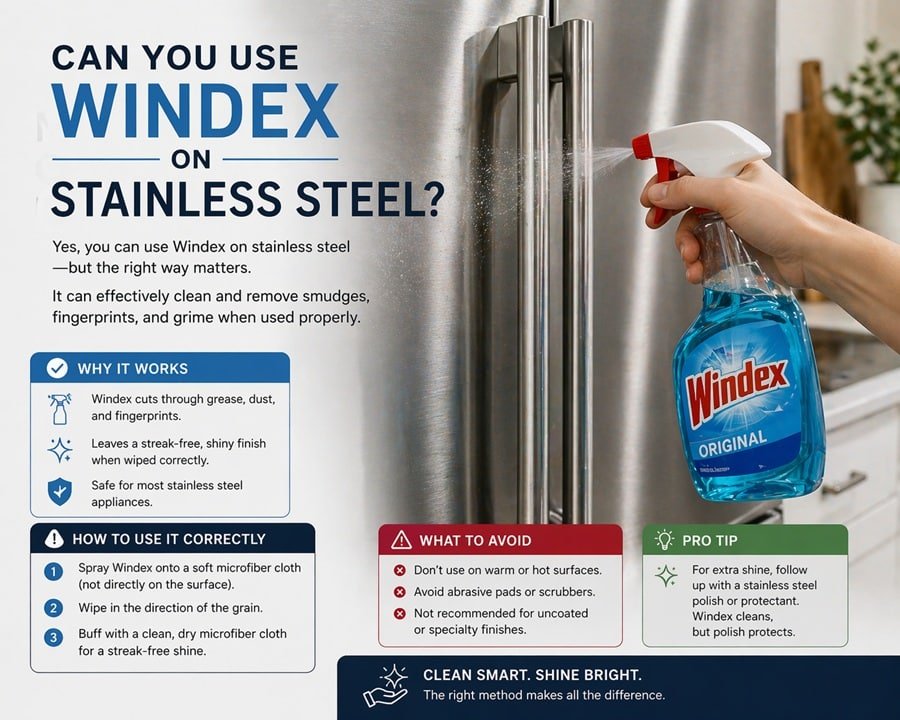
The short answer is: yes, you can — but only the right kind of Windex, only in specific situations, and almost never for the reason you think. The long answer involves a little chemistry, a lot of hands-on experience, and one decision tree that will save your finishes for good.
The Short Answer First
Original blue Windex is a bad idea for stainless steel appliances. It contains ammonia, which won’t instantly destroy your fridge but will, over time, dull the finish, strip protective coatings, and leave the streaky, cloudy buildup you’re probably fighting right now.
Windex Ammonia-Free, on the other hand, is generally safe for stainless steel — but it’s still not ideal. It’s formulated for glass, which has entirely different surface properties than brushed metal. It’ll clean, but it won’t condition, protect, or bring out the shine the way a purpose-built stainless steel product will.
So the real question isn’t can you use Windex. It’s should you — and the answer for most situations is no.
Why Ammonia and Stainless Steel Don’t Mix
This is the part most articles skip, and it’s the part that actually matters.
Stainless steel isn’t a single material. It’s a steel alloy with a thin, invisible layer of chromium oxide on the surface. That chromium layer is what makes stainless “stainless” — it self-heals when scratched and resists corrosion. It’s also what gives the metal its characteristic soft sheen.
Ammonia is a mild alkaline compound. In small, infrequent doses, it does little harm. But with repeated application, especially on warm surfaces (like a fridge door near the motor or a dishwasher that’s just finished a cycle), ammonia slowly reacts with the chromium oxide layer. The reaction isn’t dramatic — no pitting, no obvious damage on day one — but the surface gradually loses its ability to shed fingerprints, hold its polish, and reflect light evenly.
You know that “my appliance looks tired now” feeling after a few years? Ammonia-based cleaners are a major contributor.
What to Use Instead (Tiered by Budget)
The five-dollar solution that actually works
Mix equal parts white vinegar and water in a spray bottle. Spray lightly onto a microfiber cloth (not directly onto the appliance), wipe with the grain, then immediately buff with a second dry microfiber cloth. Follow up with a few drops of olive oil, mineral oil, or baby oil on a third cloth, and buff again with the grain.
That’s it. Vinegar dissolves fingerprints and greasy residue without damaging the chromium layer. The oil fills microscopic scratches in the brushed finish and repels future fingerprints for days. This is what professional cleaners use when they’re not being watched.
The mid-tier pick ($10–15)
Weiman Stainless Steel Cleaner & Polish, Method Stainless Steel Cleaner, or Therapy Stainless Steel Cleaner. All three are ammonia-free, contain mineral or plant-based oils, and leave a genuine protective layer. Weiman is the workhorse; Method smells better; Therapy has the cleanest ingredient list.
The premium option ($20+)
3M Stainless Steel Cleaner & Polish (the commercial version — same one used in high-end restaurant kitchens) or Hope’s Perfect Stainless. These are what appear in professional maintenance kits for premium appliances — Sub-Zero, Wolf, Thermador, Miele. They condition the surface more aggressively and, if used monthly, genuinely extend the life of the finish.
If you own appliances in that price range, don’t clean them with anything from a blue bottle. Ever.
The Right Way to Clean Stainless Steel (Step by Step)
Technique matters as much as product. Most streaking comes from method, not solution.
Step 1: Identify the grain
Brushed stainless steel has a directional grain — tiny parallel lines running horizontally or vertically. Get close and you’ll see them. Every wipe must go along those lines, never across them. Cross-grain wiping is the single biggest cause of streaks and fine scratches.
Step 2: Use two cloths minimum
One damp microfiber for cleaning, one dry microfiber for buffing. Paper towels leave lint, fibers, and micro-scratches — never use them on stainless. Cotton towels shed. Microfiber is non-negotiable.
Step 3: Work in sections
Don’t spray the whole fridge door and then start wiping. By the time you reach the far side, the solution has dried into streaks. Work in roughly 18-inch sections, clean and buff each one, then move on.
Step 4: Finish with oil
A dime-sized amount of mineral oil, baby oil, or a stainless-specific polish on a dry microfiber cloth, buffed in the direction of the grain. This is the step 90% of people skip, and it’s what separates “cleaned” from “gleaming.”
Step 5: Step back and check the light
Streaks only show at specific angles. Before declaring victory, walk across the room and look at the appliance from the side. If you see haze, do one more buff pass with a clean dry cloth.
Mistakes That Quietly Wreck a Finish
- Scrubbing with anything abrasive. No steel wool, no scouring pads, no Magic Erasers. Magic Erasers feel gentle but are technically a melamine foam abrasive — they’ll dull brushed stainless over time.
- Spraying directly onto the appliance. Liquid seeps into seams, control panels, gaskets, and screen edges. Always spray onto the cloth.
- Using bleach. Chlorine is far worse for stainless steel than ammonia. It pits the surface permanently and can trigger rust spots even on “stainless” metal.
- Cleaning a hot appliance. Any cleaner applied to warm stainless evaporates too fast, leaving mineral residue behind. Wait until the surface is at room temperature.
- Mixing cleaners. If you used a vinegar solution last week and Windex this week, residues can interact. Pick one method and stick with it.
- Ignoring the handle. Handles collect the most oil, get the most attention, and are almost always the first part of an appliance to look worn. Clean handles twice as often as the rest.
- Polishing new appliances. Most new stainless steel appliances come with a factory coating that shouldn’t be oiled for the first few weeks. Read the manual — if there’s a protective film, let it do its job first.
When Windex Is Actually Fine
Let’s be fair. There are cases where Windex Ammonia-Free is a reasonable choice.
- Stainless steel sinks. Sinks see soap, food, and water constantly — they don’t benefit from an oil finish anyway, since it’ll wash off immediately. A quick Windex wipe after dishwashing works fine.
- Stainless steel cookware exteriors. Pots and pans take abuse. Nobody’s hand-oiling their saucepan.
- Decorative stainless pieces. A stainless steel fruit bowl, utensil holder, or bar cart doesn’t need the full treatment.
For these low-stakes surfaces, ammonia-free Windex and a microfiber cloth is perfectly acceptable. The strict rules apply to appliances and finishes you’re trying to preserve long-term.
Frequently Asked Questions
Can you use regular blue Windex on stainless steel appliances?
Technically yes, damagingly yes. The ammonia in original Windex slowly degrades the protective chromium oxide layer on stainless steel. One-time use won’t ruin anything, but repeated application dulls the finish, causes streaking, and shortens the life of the surface. Use ammonia-free Windex at minimum, or better yet, a dedicated stainless steel cleaner.
Does Windex streak on stainless steel?
Yes, almost always — because it’s designed for glass, which has a non-porous, non-directional surface. Stainless steel has a grain that must be wiped along, and Windex leaves a residue that shows up as streaks on brushed finishes. If you’re fighting streaks, the cleaner is likely the problem as much as the technique.
What’s the best homemade stainless steel cleaner?
Equal parts white vinegar and water in a spray bottle, followed by a light buff with mineral oil or olive oil on a dry microfiber cloth. It costs pennies per use, works as well as most commercial products, and won’t damage the chromium layer.
Is Windex Ammonia-Free safe on stainless steel?
Safer than original Windex, yes. Ideal for appliances, no. It’ll clean without damaging the surface, but it won’t condition or protect it. For fridges, ovens, dishwashers, and range hoods, a dedicated stainless steel cleaner will deliver noticeably better results.
Why does my stainless steel fridge look worse after cleaning?
Three likely reasons: you wiped against the grain, you used paper towels or a cotton cloth that left lint, or the cleaner dried before you buffed it. Switch to microfiber, work in small sections, and finish with a dry buff along the grain. The difference is immediate.
How often should I clean stainless steel appliances?
Wipe handles and high-touch areas every few days with a dry microfiber cloth. Do a full clean (vinegar or dedicated cleaner) every 2–3 weeks. Oil-polish once a month. More than that is overkill and can cause oil buildup.
The Takeaway
So, can you use Windex on stainless steel? Technically yes — but if you care how your appliances look in three years, you shouldn’t. Original Windex is mildly corrosive to the chromium oxide layer that makes stainless “stainless.” Ammonia-free Windex is acceptable but uninspired. The real answer is a $3 spray bottle of vinegar and water, a $4 bottle of mineral oil, two microfiber cloths, and the discipline to wipe along the grain.
That’s the whole secret. The products don’t matter nearly as much as the method. Get the technique right, and even a rental-grade fridge can look showroom-fresh. Get it wrong, and a $10,000 Sub-Zero ends up looking tired by year two.
Clean with the grain. Buff dry. Finish with oil. Skip the blue bottle.


Benjamin Ortiz is a digital marketing expert. He currently runs an SEO agency and a survival gear review blog.