
How to Choose a Pet Portrait Size That Feels Right in Your Room
A pet portrait can look perfectly proportioned on a product page and surprisingly small once it reaches a real wall. The difference is context. A living room wall, a narrow hallway, and a shelf beside your desk ask the artwork to do very different jobs. The best size is not determined by your pet’s breed or by the most popular option. It depends on where the portrait will live, how you will view it, and whether it should act as a quiet accent or the room’s focal point.
This guide gives you a simple way to make that decision before you order or put a hole in the wall.
Start With the Wall Instead of the Artwork
Choose the exact location first. “Somewhere in the living room” is still too broad. A portrait centered above a sofa needs more visual presence than one beside a bookcase, even when both are in the same room.
Measure the usable area rather than the entire wall. Leave out the space occupied by lamps, tall plants, switches, shelves, and doors. If the portrait will hang above furniture, measure the width of that piece as well. The artwork should feel connected to the sofa, console, desk, or headboard below it, not like a small object floating in empty space.
Next, decide what role the portrait should play:
- An intimate accent works well on a shelf, desk, narrow wall, or within a larger gallery arrangement.
- A room anchor should be easy to notice from the doorway or main seat without overwhelming the furniture around it.
- A statement piece needs enough clear wall space to stand on its own.
This first decision quickly removes sizes that are technically available but wrong for the room.
Check the Normal Viewing Distance
Where will you usually see the portrait from? A small piece can feel detailed and personal when viewed from a desk chair. The same piece may lose its impact when seen from across an open living room.
Walk to the place where you will normally enter, sit, or pass the artwork. From there, look at the empty wall. If you want to notice your pet’s eyes and expression from that position, choose a size that keeps the face visually clear. If the portrait is meant for close viewing, such as a hallway or reading corner, a smaller format may feel more natural.
The composition matters too. A close-up of one pet can remain readable at a smaller size. Two or more pets, a full-body pose, or a detailed background usually benefits from more room because each face occupies a smaller share of the finished artwork.
When browsing custom pet Art Prints from Pawfolio Art, look at the size in relation to the number of pets and the intended viewing distance, not only at the product image on your screen.
Make a Full Size Paper Test
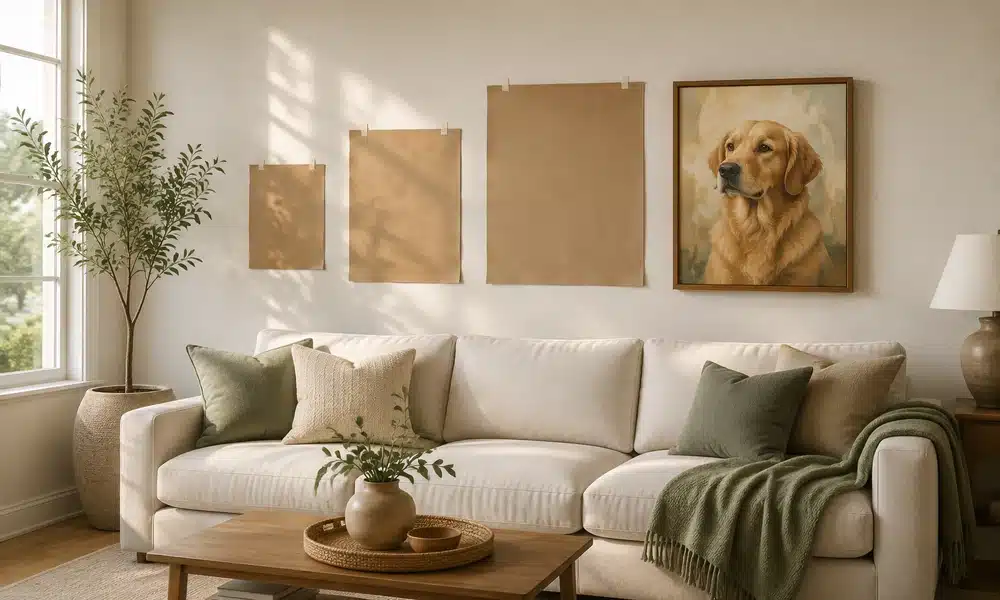
The most reliable sizing tool costs almost nothing. Cut kraft paper, newspaper, or spare wrapping paper to the exact dimensions you are considering. If you do not have one sheet large enough, tape several pieces together.
Attach the template with wall-safe painter’s tape, then check it from several positions:
- Stand at the room entrance.
- Sit in the chair or on the sofa where you will see it most often.
- Look at it beside the furniture and objects that will remain in the room.
- Leave it up until the next day and check it in both daylight and evening light.
Ask whether the shape feels lost, balanced, or crowded. Try the next size up or down rather than talking yourself into the first option. A few minutes with two paper templates gives you better information than repeatedly zooming in and out on a phone.
Remember to outline the finished dimensions. An external frame can make the whole piece noticeably larger than the printed image, while a print displayed without one keeps a slimmer profile.
Match the Size to the Room’s Job
Different rooms reward different kinds of presence.
Living Room
In a living room, the portrait often competes with the sofa, television, windows, and other art. A single small piece can disappear above wide furniture. Test a larger portrait or group it with a few related pieces so the overall arrangement has enough width.
If the room already contains patterned textiles, shelves, or several strong colors, keep the surrounding wall arrangement simpler. A larger single portrait may look calmer than many small frames.
Bedroom
A bedroom usually suits a quieter scale. Above a dresser or beside a reading chair, a medium piece can feel personal without dominating the room. Above a wide headboard, however, the artwork still needs enough presence to relate to the furniture below it.
Hallway and Stair Landing
These areas are viewed at close range, so smaller portraits can work well. A matching sequence of frames can create rhythm along a long hallway, while one well-placed portrait can give a landing a clear focal point. Keep the arrangement narrow enough that it does not make a tight passage feel busier.
Home Office
A portrait near a desk can be compact because you will see it from only a few feet away. Think about video-call backgrounds as well. One clearly placed piece usually reads better on camera than several tiny items scattered across the wall.
Choose the Physical Format With the Size
Size and material should be decided together. A flat Art Print has a slim, classic presence and can be displayed print-only or with an external frame. A gallery-wrapped Canvas is stretched over an inner wood frame, so it brings visible depth to the wall even without a decorative outer frame.
That difference becomes more noticeable as the artwork gets larger. A large Canvas can feel architectural because of its wrapped edges and depth. A framed Art Print may feel more integrated with photographs, illustrations, and other framed pieces in a gallery wall.
There is no universal winner. Use the room’s existing finishes as a guide. If you are still deciding, you can compare Art Prints and Canvas by construction, profile, available sizes, and display style before choosing the final format.
Account for the Pet and the Source Photo
The portrait’s emotional focus is the pet, but the room still determines the outside dimensions. Within that space, make sure the composition gives the important details enough room.
A clear head-and-shoulders photo often adapts easily to several sizes. A full-body pose, multiple pets, or a scene with meaningful background details may look better at a larger scale. Avoid choosing a very large piece simply to compensate for a blurry or distant photo. Increasing the physical size cannot restore details that were not visible in the source image.
If you are ordering a surprise gift, choose a size that is flexible to display unless you know the recipient’s wall measurements. A modest framed piece can move between a shelf, office, bedroom, or gallery wall more easily than a large statement work.
Use a Final Five Point Check
- You know the exact wall or surface where the portrait will go.
- You measured the usable area and nearby furniture.
- You checked the portrait from the normal viewing position.
- You tested the complete outside dimensions with paper.
- You considered the number of pets, composition, frame, and physical format together.
The right pet portrait size should feel intentional in the room and still let your pet’s expression hold attention. Start with the space, test the outline, and let the real wall make the decision.


Benjamin Ortiz is a digital marketing expert. He currently runs an SEO agency and a survival gear review blog.
