Rigid PVC Film vs Semi-Rigid PVC Film: Understanding the Differences for Interior Applications
PVC film has become an important material in modern interior design due to its versatility, durability, and cost-effectiveness. It is widely used for furniture surfaces, wall panels, doors, cabinets, flooring, and decorative applications.
Among the different types of PVC films available, rigid and semi-rigid PVC films are two commonly used options for interior decoration film solutions.
Although both materials are made from polyvinyl chloride (PVC), they have different properties, processing methods, and ideal application scenarios. Understanding the differences between rigid PVC film and semi-rigid PVC film helps designers, manufacturers, and buyers choose the right material for specific interior projects.
What Is Rigid PVC Film?
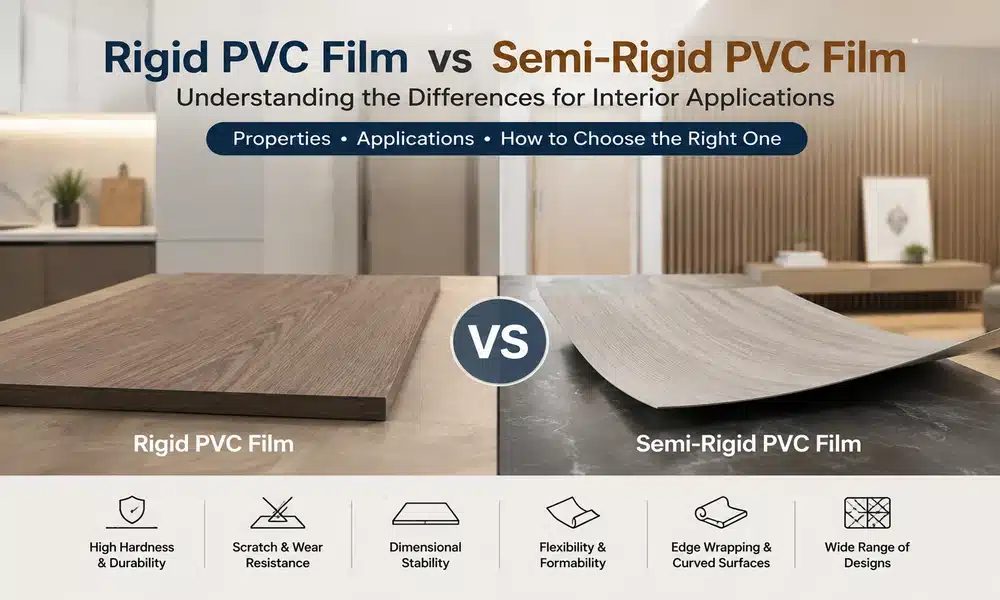
Rigid PVC film is a type of PVC decorative film with a high level of hardness and structural stability. It contains little or no plasticizer, which allows the film to maintain its shape and resist deformation under pressure or temperature changes.
Due to its strong mechanical properties, rigid PVC film is commonly used in applications where durability, dimensional stability, and surface protection are important.
Key Characteristics of Rigid PVC Film
1. High Hardness and Strength
Rigid PVC film has excellent stiffness and resistance to impact. It can maintain a flat and stable surface even when applied to large panels or furniture components. This makes it suitable for applications that require long-term performance.
2. Excellent Surface Protection
The hard surface of rigid PVC film provides strong resistance against scratches, abrasion, and daily wear. In high-use areas such as kitchens, offices, and commercial interiors, rigid PVC film helps maintain the appearance of surfaces for longer periods.
3. Strong Dimensional Stability
Rigid PVC film has low flexibility and limited expansion or contraction. This makes it suitable for precise applications where surface flatness and shape retention are required.
4. Easy Printing and Decorative Processing
Rigid PVC film can be manufactured with various surface finishes, including wood grain, stone patterns, solid colors, and metallic effects. Embossing technology can also create realistic textures that imitate natural materials.
Common Applications of Rigid PVC Film
Rigid PVC film is often used for:
- Kitchen cabinet panels
- Furniture boards
- Wall cladding panels
- Interior doors
- Decorative laminates
- Commercial display surfaces
- Hard surface protection layers
For example, in modern kitchen design, rigid PVC film can be laminated onto MDF or particle board panels to create durable cabinet doors with a wood or stone appearance.
What Is Semi-Rigid PVC Film?
Semi-rigid PVC film is a more flexible version of PVC film. It contains a controlled amount of plasticizer, giving it a balance between hardness and flexibility. Compared with rigid PVC film, semi-rigid PVC film can better adapt to curved surfaces, irregular shapes, and complex designs.
This flexibility makes it a popular choice for decorative applications where surface forming ability is important.
Key Characteristics of Semi-Rigid PVC Film
1. Better Flexibility
The main advantage of semi-rigid PVC film is its ability to bend and stretch without cracking. It can be applied to curved edges, profiles, and three-dimensional surfaces.
2. Good Formability
Semi-rigid PVC film performs well in vacuum forming and profile wrapping processes. Manufacturers can use it to cover furniture components with complex shapes while maintaining a smooth decorative appearance.
3. Lightweight and Easy Processing
Because of its flexibility, semi-rigid PVC film is easier to handle during installation and manufacturing. It reduces processing difficulties when working with curved or detailed components.
4. Wide Design Possibilities
Like rigid PVC film, semi-rigid PVC film is available in many decorative options, including wood textures, fabric patterns, marble effects, and customized prints.
Common Applications of Semi-Rigid PVC Film
Semi-rigid PVC film is widely used for:
It is especially suitable for projects requiring seamless wrapping around corners and curved structures.
Rigid PVC Film vs Semi-Rigid PVC Film: Key Differences
Although both materials share similar advantages, several differences affect their performance in interior applications.
| Feature | Rigid PVC Film | Semi-Rigid PVC Film |
|---|---|---|
| Hardness | Higher hardness and stiffness | Moderate hardness with flexibility |
| Flexibility | Limited flexibility | Excellent flexibility |
| Surface Protection | Better scratch and impact resistance | Good protection but softer surface |
| Formability | Suitable for flat surfaces | Better for curved and complex shapes |
| Processing Method | Lamination and flat pressing | Vacuum forming and profile wrapping |
| Shape Retention | Excellent stability | More adaptable but less rigid |
| Typical Uses | Cabinets, panels, doors | Profiles, edges, curved furniture |
Conclusion
Rigid PVC film and semi-rigid PVC film both play important roles in modern interior applications, but they serve different purposes. Rigid PVC film provides superior hardness, durability, and stability for flat and high-wear surfaces, while semi-rigid PVC film offers better flexibility and forming ability for curved and complex designs.
For furniture manufacturers, interior designers, and material buyers, selecting the right PVC film depends on the application requirements, processing method, and desired aesthetic effect. By understanding the differences between these two materials, businesses can achieve better performance, longer service life, and more attractive interior designs.